

Introduction to PLCs
A PLC is installed in an electrical panel and can control different actuators such as valves, motors or cylinders. It can also receive data from different components, such as inductive, pressure or temperature sensors.
Where needed, we supply all the sensors and actuators from the best brands on the market as part of the automation solution, guaranteeing a complete solution with the highest level of reliability.
A solution built around a PLC is usually accompanied by a physical screen with control and visualisation software, or by a SCADA running on a computer, which maximises the performance of the automation. You will find more information about these systems in the SCADA section of our website.
Industrial automation and PLCs make it possible to automate and create solutions for all kinds of applications, usually in the industrial sector. Here are just a few of the applications that automation makes possible:
- Manufacturing a product using automatic valves, with agitation and monitoring of sensors such as temperature or pressure.
- Level control of raw material vessels or tanks used to manufacture a product.
- Industrial automation of a whole factory with assembly lines, from the arrival of raw materials at the warehouse to the packaging and dispatch of the finished product.
- Control of all kinds of machines (bottling machines, agitators, dosing units...).
Most industrial applications can be automated. Do not hesitate to contact us if you would like to automate a project: our professionals will study your proposal to offer you the best possible solution.

Our experience
At FMJ Ingenieros we are experts in automation programming:
We adapt to every project, always using the PLC that best suits the customer.
We specialise in Siemens automation in all its variants, from the simplest applications with the S7-1200 to the most powerful ones with the S7-1500 or distributed I/O with ET 200SP and ET 200.
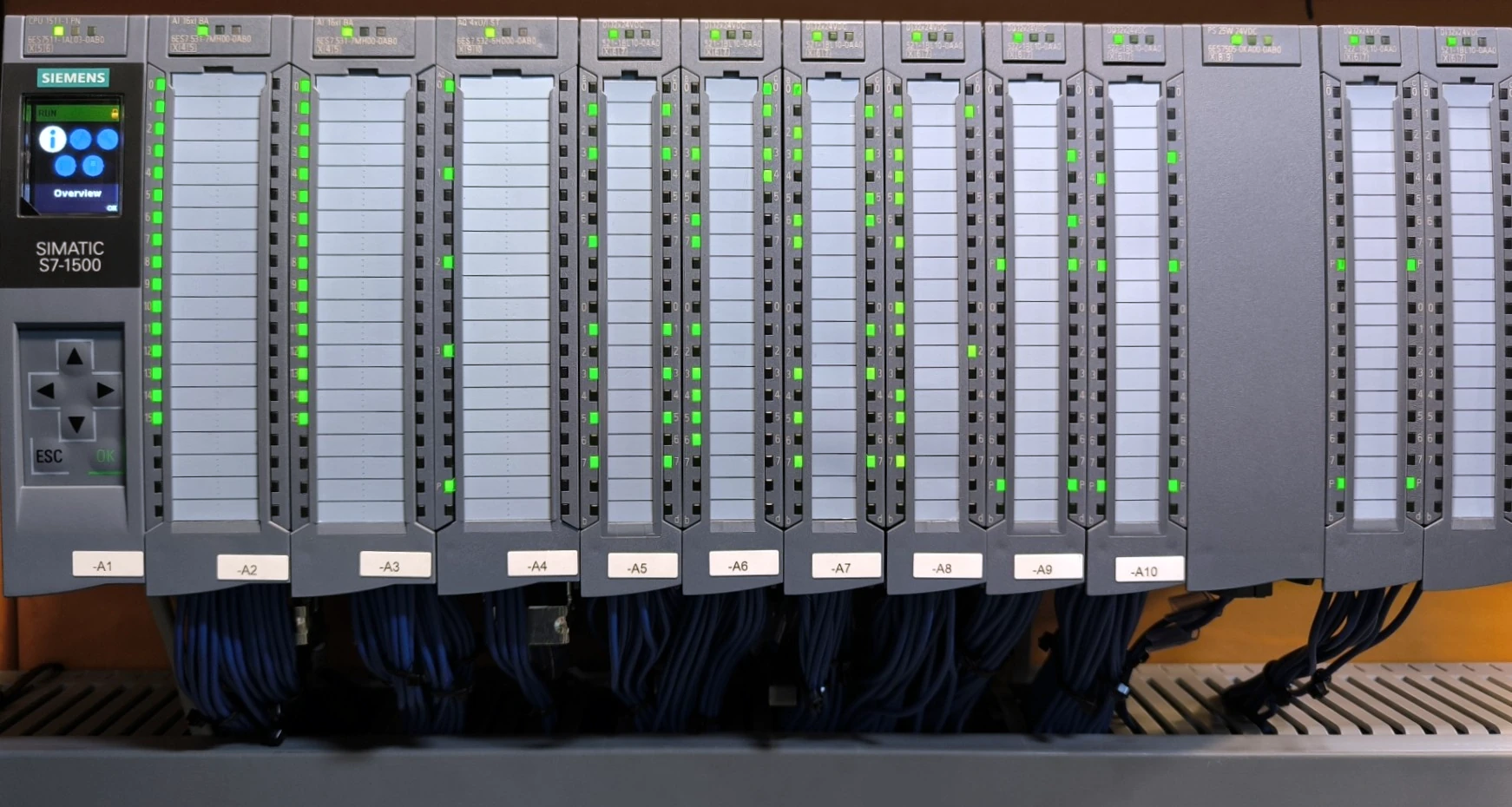
We also work with brands such as:
- Omron
- Rockwell (Allen-Bradley)
- Schneider Electric
- Mitsubishi
- Eaton (Moeller)

A personal relationship with the customer is one of our hallmarks.
Before choosing the PLC and writing the program, all the characteristics the solution requires are detailed and defined together with the customer. Once the study that guarantees the correct operation of the application is complete, the programming is carried out on the chosen PLC.
The PLC today: more than control logic
The PLC is no longer an isolated device that simply runs sequences. Today's controllers integrate industrial Ethernet, a web server, safety functions and the ability to exchange data with SCADA systems, databases and business applications. Machine information reaches the people who need it without going through paper.
When planning a new installation or modernising an existing one, these are the aspects we focus on with the customer:
- Structured programming to IEC 61131-3 (ladder diagram, function blocks, structured text, SFC), with reusable, well-documented blocks that make future maintenance easier.
- Migration of obsolete PLCs: many older families are discontinued or being phased out, and spare parts are increasingly hard to find. Migrating to a current platform reduces the risk of downtime and opens the door to new functionality.
- Connectivity: open protocols such as OPC UA, Modbus TCP or MQTT to integrate the PLC with SCADA, Historian and IT systems without depending on a single vendor.
- Safety: machine safety functions (safety PLCs, emergency stops, light curtains) and protected access to the control network.
- Diagnostics: clear alarms and I/O diagnostics to locate a fault in minutes rather than hours.
A good PLC program is not only one that works on commissioning day, but one that another engineer can understand and extend years later. That is why we always deliver a commented program and complete project documentation.